> ## Documentation Index
> Fetch the complete documentation index at: https://docs.cortex.foundation/llms.txt
> Use this file to discover all available pages before exploring further.
# Attachments and files
> Send a file with a message: what Cortex Chat accepts, the 10 MB ceiling, what text is read out of a document, and where uploads land
You can send a file along with a message in Cortex Chat. Pick it from your computer, drag it onto the composer, or choose one you already have in Library or on a connected cloud drive. The file is uploaded, kept in [Library](/chat/library), and referenced by the turn you attached it to.
This page covers how to attach a file, what Chat accepts, the size ceiling and where it is enforced, what Cortex can read out of a document, and the messages you see when an upload or an extraction does not work.
 ## Attach a file
Click **Attach a file** in the composer. The menu offers a local file, **From your Library**, and **Cloud drives**. A drive you have not connected shows **Connect** instead of a file list.
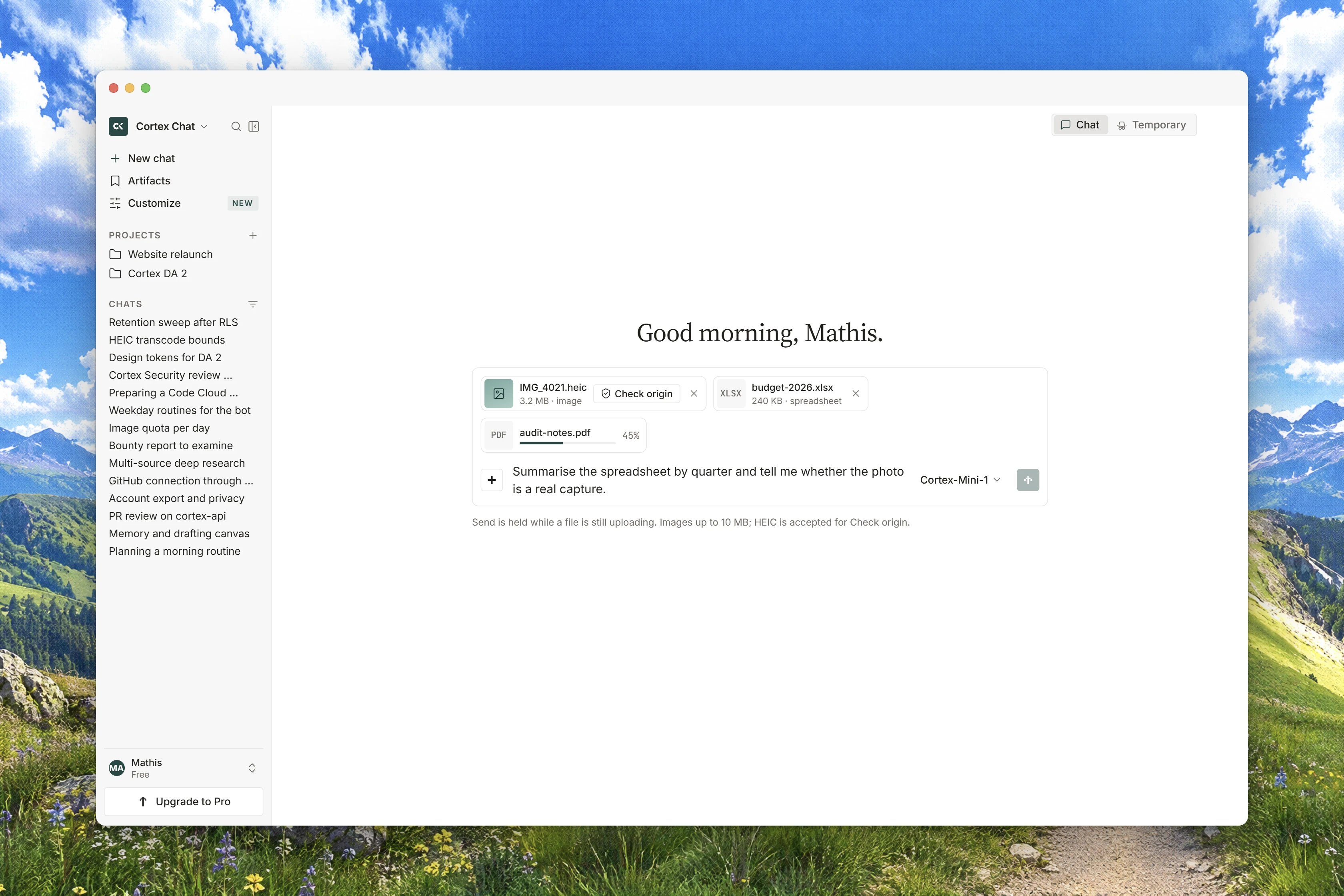
The file appears as a chip above the composer. It reads **Uploading…** with a percentage while the transfer runs, then settles to the file name. The chip states the ceiling: **10 MB max**.
**Remove** with the file name drops the attachment. The same button cancels an upload that is still running.
Write your question and send. The file is in Library afterwards, so you can attach it again later without uploading it a second time.
Images and video have their own control, **Add image or video**, which builds a small rail of media instead of document chips. It refuses anything that is not one of those with **That file is not an image or video the composer can attach.**
## What Chat accepts
| Kind | Extensions |
| ----------------- | ---------------------------------------- |
| Images | `.png`, `.jpg`, `.jpeg`, `.webp`, `.gif` |
| Video | `.mp4`, `.webm`, `.mov` |
| Documents | `.pdf`, `.docx`, `.xlsx` |
| Text and data | `.json`, `.txt`, `.md`, `.csv` |
| Origin check only | `.heic`, `.heif` |
A file type outside this list is refused as an unsupported media type. See [Unsupported media type](/problems/unsupported_media_type).
Photos in the `.heic` and `.heif` formats are accepted for a provenance check but not as chat images. The message says so: **HEIC photos can be checked for origin. Use Check origin, or convert to JPEG or PNG.** See [Check origin](/chat/origin-check).
## The size ceiling is 10 MB
The composer applies a single limit of **10 MB per file**, and it applies to everyone. The check happens in your browser before the upload starts, so an oversized file is refused straight away instead of wasting a long transfer. The media rail refuses the same way, with **That file is larger than the attach limit.**
If a file is too large, the fix is to split it, export a smaller range, or attach the relevant part as text.
Uploading requires an account. Signed out, you get a working conversation but no uploads. If an upload is refused on your plan before the size check even runs, that is an entitlement refusal rather than a size problem, and [Entitlement required](/problems/entitlement_required) explains what to do.
A message that is rejected for size, whether it is the file or the text of the message itself, shows up as [Payload too large](/problems/payload_too_large).
## What Cortex reads out of a file
Uploading is only half the job. Cortex then tries to read text out of what you sent, and the chip says **Reading** with the file name while that happens.
| File | What happens |
| ------------------------------ | ------------------------------------------------------------------------------------- |
| `.docx` and `.xlsx` | The text is pulled out and included with your message |
| `.pdf` | Attached and referred to by name, rather than having its text pulled into the message |
| `.txt`, `.md`, `.csv`, `.json` | Read as the text they already are |
| Encrypted or damaged files | Nothing is read, and you are told rather than left guessing |
An unreadable file fails plainly: **That file is encrypted or unreadable. Cortex did not extract it.** If that happens on a document you know is fine, an export to plain text or a re-save from the original application usually fixes it.
When an answer quotes something from a file, the citation names the file and the place inside it, so a claim can be checked against the source. The shape is the file name followed by a locator, for example `report.pdf · p.12` or `forecast.xlsx · Sheet 1`.
## Images
You can attach an image, and the composer will upload it like anything else. What a model does with it is another matter: neither model published in Chat today advertises image understanding, so do not build a question around Cortex reading what is inside a picture. See [Models and thinking](/chat/models).
There is one thing a picture is definitely good for. If your question is whether an image was generated or edited rather than what it shows, run it through [Check origin](/chat/origin-check), which is built for exactly that and accepts the widest set of photo formats.
## Where uploads land
Every file you attach is stored in [Library](/chat/library), not only inside the conversation. Two consequences are worth knowing:
* Deleting a chat does not delete the files you attached to it. They stay in Library until you remove them there.
* A file already in Library can be attached to any later chat through **From your Library**, with no second upload.
Files are yours alone. Chat is per account, so an attachment is visible only to the account that uploaded it. Sharing a result means exporting or copying it, as described in [Sharing and teams](/chat/sharing).
## When an upload will not work
The transfer did not complete. The chip turns to an error state and keeps the file name. Remove the chip and attach the file again; if it fails repeatedly on a large file, check your connection before blaming the file.
It is refused before the upload starts, so nothing was transferred. Reduce or split the file.
The file uploaded but could not be read, which is usually password protection or corruption. The file is still in Library; the text simply did not reach the model.
Attaching needs an account. Sign in with your Cortex account and the control appears.
## Related
* [Library](/chat/library) - where every upload and generated file is kept.
* [Check origin](/chat/origin-check) - test whether a photo was generated or edited.
* [Models and thinking](/chat/models) - what the current models do and do not handle.
* [How Chat works](/chat/how-it-works) - how an attachment becomes part of a turn.
* [Chat troubleshooting](/chat/troubleshooting) - upload and extraction messages in context.
## Attach a file
Click **Attach a file** in the composer. The menu offers a local file, **From your Library**, and **Cloud drives**. A drive you have not connected shows **Connect** instead of a file list.
The file appears as a chip above the composer. It reads **Uploading…** with a percentage while the transfer runs, then settles to the file name. The chip states the ceiling: **10 MB max**.
**Remove** with the file name drops the attachment. The same button cancels an upload that is still running.
Write your question and send. The file is in Library afterwards, so you can attach it again later without uploading it a second time.
Images and video have their own control, **Add image or video**, which builds a small rail of media instead of document chips. It refuses anything that is not one of those with **That file is not an image or video the composer can attach.**
## What Chat accepts
| Kind | Extensions |
| ----------------- | ---------------------------------------- |
| Images | `.png`, `.jpg`, `.jpeg`, `.webp`, `.gif` |
| Video | `.mp4`, `.webm`, `.mov` |
| Documents | `.pdf`, `.docx`, `.xlsx` |
| Text and data | `.json`, `.txt`, `.md`, `.csv` |
| Origin check only | `.heic`, `.heif` |
A file type outside this list is refused as an unsupported media type. See [Unsupported media type](/problems/unsupported_media_type).
Photos in the `.heic` and `.heif` formats are accepted for a provenance check but not as chat images. The message says so: **HEIC photos can be checked for origin. Use Check origin, or convert to JPEG or PNG.** See [Check origin](/chat/origin-check).
## The size ceiling is 10 MB
The composer applies a single limit of **10 MB per file**, and it applies to everyone. The check happens in your browser before the upload starts, so an oversized file is refused straight away instead of wasting a long transfer. The media rail refuses the same way, with **That file is larger than the attach limit.**
If a file is too large, the fix is to split it, export a smaller range, or attach the relevant part as text.
Uploading requires an account. Signed out, you get a working conversation but no uploads. If an upload is refused on your plan before the size check even runs, that is an entitlement refusal rather than a size problem, and [Entitlement required](/problems/entitlement_required) explains what to do.
A message that is rejected for size, whether it is the file or the text of the message itself, shows up as [Payload too large](/problems/payload_too_large).
## What Cortex reads out of a file
Uploading is only half the job. Cortex then tries to read text out of what you sent, and the chip says **Reading** with the file name while that happens.
| File | What happens |
| ------------------------------ | ------------------------------------------------------------------------------------- |
| `.docx` and `.xlsx` | The text is pulled out and included with your message |
| `.pdf` | Attached and referred to by name, rather than having its text pulled into the message |
| `.txt`, `.md`, `.csv`, `.json` | Read as the text they already are |
| Encrypted or damaged files | Nothing is read, and you are told rather than left guessing |
An unreadable file fails plainly: **That file is encrypted or unreadable. Cortex did not extract it.** If that happens on a document you know is fine, an export to plain text or a re-save from the original application usually fixes it.
When an answer quotes something from a file, the citation names the file and the place inside it, so a claim can be checked against the source. The shape is the file name followed by a locator, for example `report.pdf · p.12` or `forecast.xlsx · Sheet 1`.
## Images
You can attach an image, and the composer will upload it like anything else. What a model does with it is another matter: neither model published in Chat today advertises image understanding, so do not build a question around Cortex reading what is inside a picture. See [Models and thinking](/chat/models).
There is one thing a picture is definitely good for. If your question is whether an image was generated or edited rather than what it shows, run it through [Check origin](/chat/origin-check), which is built for exactly that and accepts the widest set of photo formats.
## Where uploads land
Every file you attach is stored in [Library](/chat/library), not only inside the conversation. Two consequences are worth knowing:
* Deleting a chat does not delete the files you attached to it. They stay in Library until you remove them there.
* A file already in Library can be attached to any later chat through **From your Library**, with no second upload.
Files are yours alone. Chat is per account, so an attachment is visible only to the account that uploaded it. Sharing a result means exporting or copying it, as described in [Sharing and teams](/chat/sharing).
## When an upload will not work
The transfer did not complete. The chip turns to an error state and keeps the file name. Remove the chip and attach the file again; if it fails repeatedly on a large file, check your connection before blaming the file.
It is refused before the upload starts, so nothing was transferred. Reduce or split the file.
The file uploaded but could not be read, which is usually password protection or corruption. The file is still in Library; the text simply did not reach the model.
Attaching needs an account. Sign in with your Cortex account and the control appears.
## Related
* [Library](/chat/library) - where every upload and generated file is kept.
* [Check origin](/chat/origin-check) - test whether a photo was generated or edited.
* [Models and thinking](/chat/models) - what the current models do and do not handle.
* [How Chat works](/chat/how-it-works) - how an attachment becomes part of a turn.
* [Chat troubleshooting](/chat/troubleshooting) - upload and extraction messages in context.