

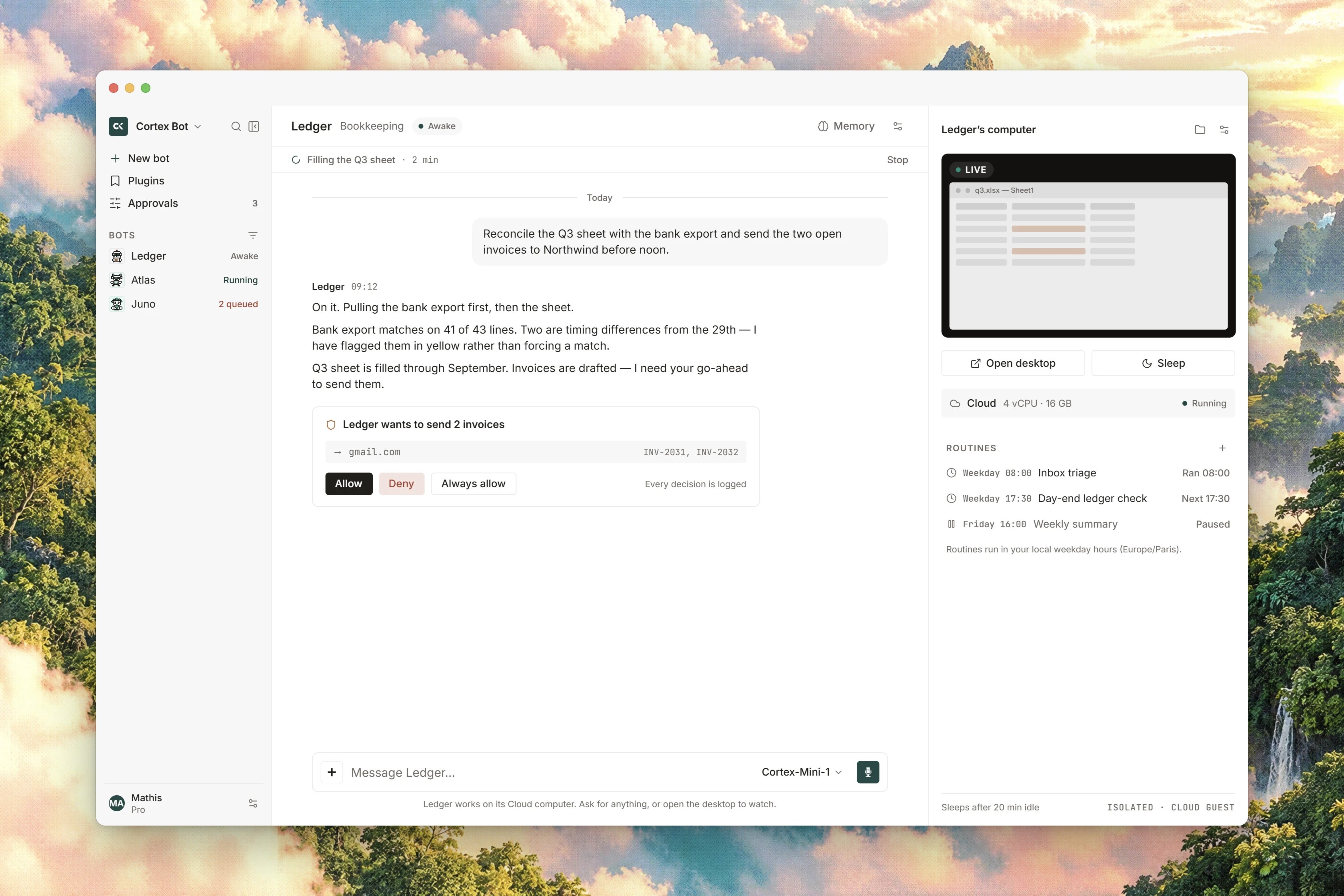
Interface preview
Start here
Bot quickstart
Sign in, create a bot, open its computer, give it a task, approve its first consequential step.
How Bot works
The turn in user terms: no round limit, a deadline, a stuck guard, wake cues, and what actually reaches you.
Your bots
Create a bot
The New bot form: name, look and face, description, label, notifications, skills and connectors.
Talking to a bot
Direct messages, suggested asks, questions the bot puts to you, drafts it wants to send, and the status words.
Computer
The Computer rail: the live desktop, taking control, recordings, sleep and wake, and where it runs.
Bot tools
The catalog a bot receives: files and shell, desktop verbs, browser and web, memory, skills, tasks and connected apps.
Approvals and tool policy
Allow, Deny and Always, which tools always ask, the policy tiers, and where pending decisions collect.
Memory
Profile, log and notes: what a bot carries between turns, and how that differs from Chat memory.
Skills
Recipes a bot may follow, the scan that gates them, and how a bot picks one.
Routines
Recurring work on one bot, in your local weekday hours, with pause, resume and run history.
Tasks and subagents
Nested work a bot dispatches inside a turn, the one desktop worker rule, cancelling, and bot-to-bot messages.
Connected apps and secrets
Assign a connected app to one bot, how its tools ask for approval, and the sealed vault behind a secret request.
Inbox
Everything that needs you across every bot you own, with the Working, Pending, Inbox and All filters.
Collaborate and extend
Channels
Group threads for the bots you own. Create a channel, add members, then address one bot in the composer.
Share a bot
Email invites, the independent copy a recipient gets, and what a shared bot never carries with it.
Teach from a demonstration
Show the bot how to do something on its computer, review the draft, and save it as a skill.
Bot desktop app
A desktop application built around Bot alone, with no Chat or Code sidebar.
Bot troubleshooting
A desktop that will not start, a stream that will not connect, parked steps, and turns that stop early.
What a bot is
An account can have up to 24 bots. That ceiling is the same for every account.
Where things are
The Bot sidebar is one narrow column. At the top are four actions: New bot, Routines, Plugins and Approvals. Under the BOTS heading is one row per bot, with its status on the right, and under CHANNELS one row per channel. An account with no bots gets the setup form rather than a list, and an account with no channels readsNo channels yet.
Open a bot and the pane has tabs for Messages, Computer, Videos and VNC. A bot you can choose to leave Awake, Resting or Hibernating; the other status words you see, such as Starting…, Running, Hibernated, Stopped, Archived and Error, describe what its computer is doing and are reported by Cortex rather than chosen by you.
Several Bot surfaces are drawn in the interface but are not wired up yet, and nothing happens when you use them: multi-bot rooms, importing and exporting a bot pack, duplicating a bot, browsing and downloading workspace files, inbound mail, live voice, the phone-width Companion column and the cost ledger. Each one says so in the product when you open it.
How it fits with the other products
Chat and Code are two modes of one engine. Bot is a separate loop, which is why per-tool approvals exist here in full and the turn is not capped in rounds.
A bot can also open a piece of work in Cortex Code through Open in Code in its conversation. Cortex Design has a page for handing a design task to a bot, and that feature is not available yet.
Related
- Bot quickstart - create a bot and give it a first task.
- How Bot works - the turn, the stop conditions and the wake cues.
- Approvals and tool policy - decide what a bot may do without asking.
- Cortex Chat and Cortex Code - the two products a bot sits beside.
- Limits and quotas - every user-facing limit in one table.