

What Code is
Who can open it
Code is a member surface. A guest who visits the Code area sees the public product page, and a guest on a deep link sees This space is reserved, with Continue in Chat or Sign in. Once you are signed in, Code Home is the composer itself. Its heading reads What should Cortex build? and its prompt box reads Ask Cortex to build, fix, explore. A guest can type there, but pressing Start session opens the sign-in dialog. That is an invitation, not an error.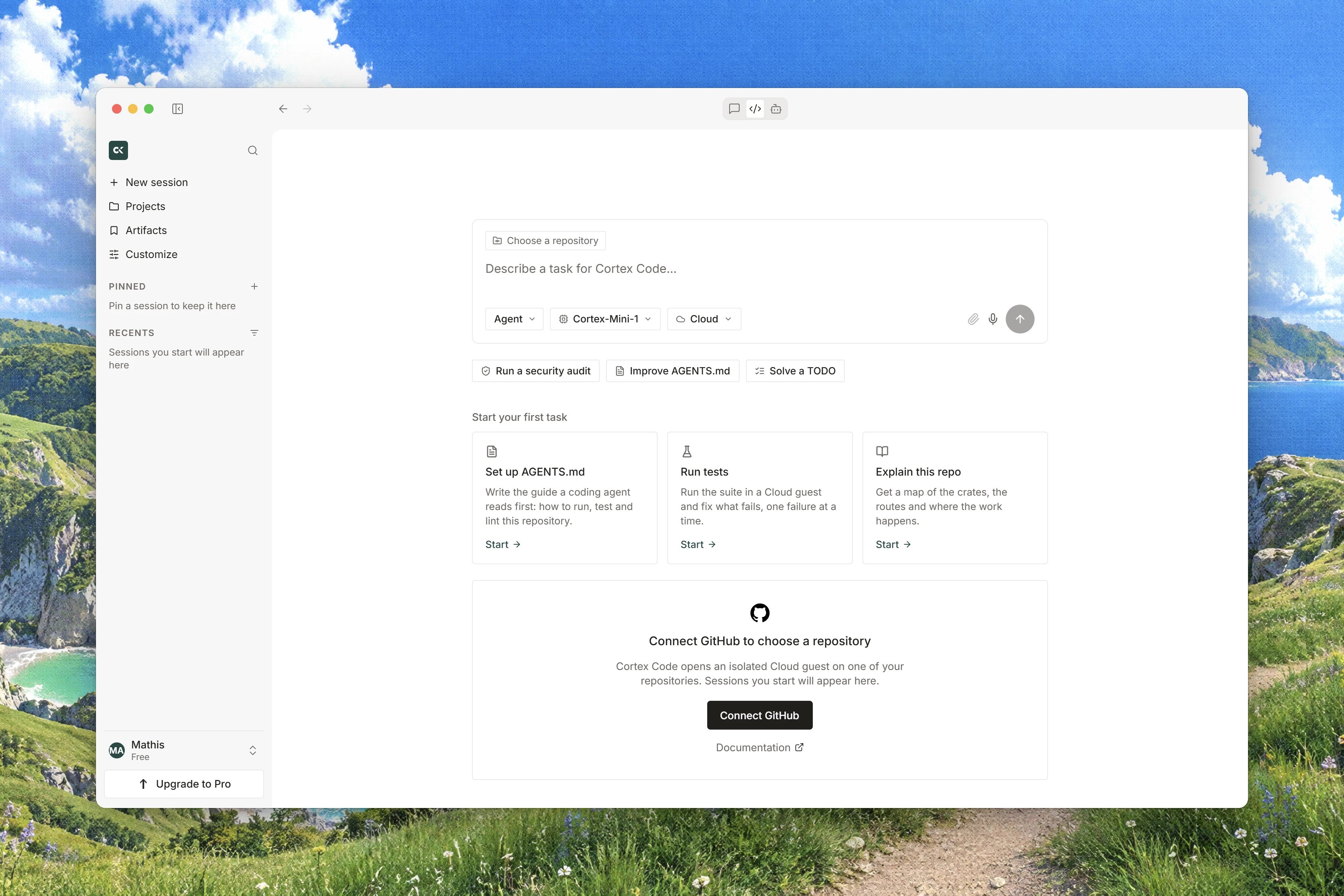
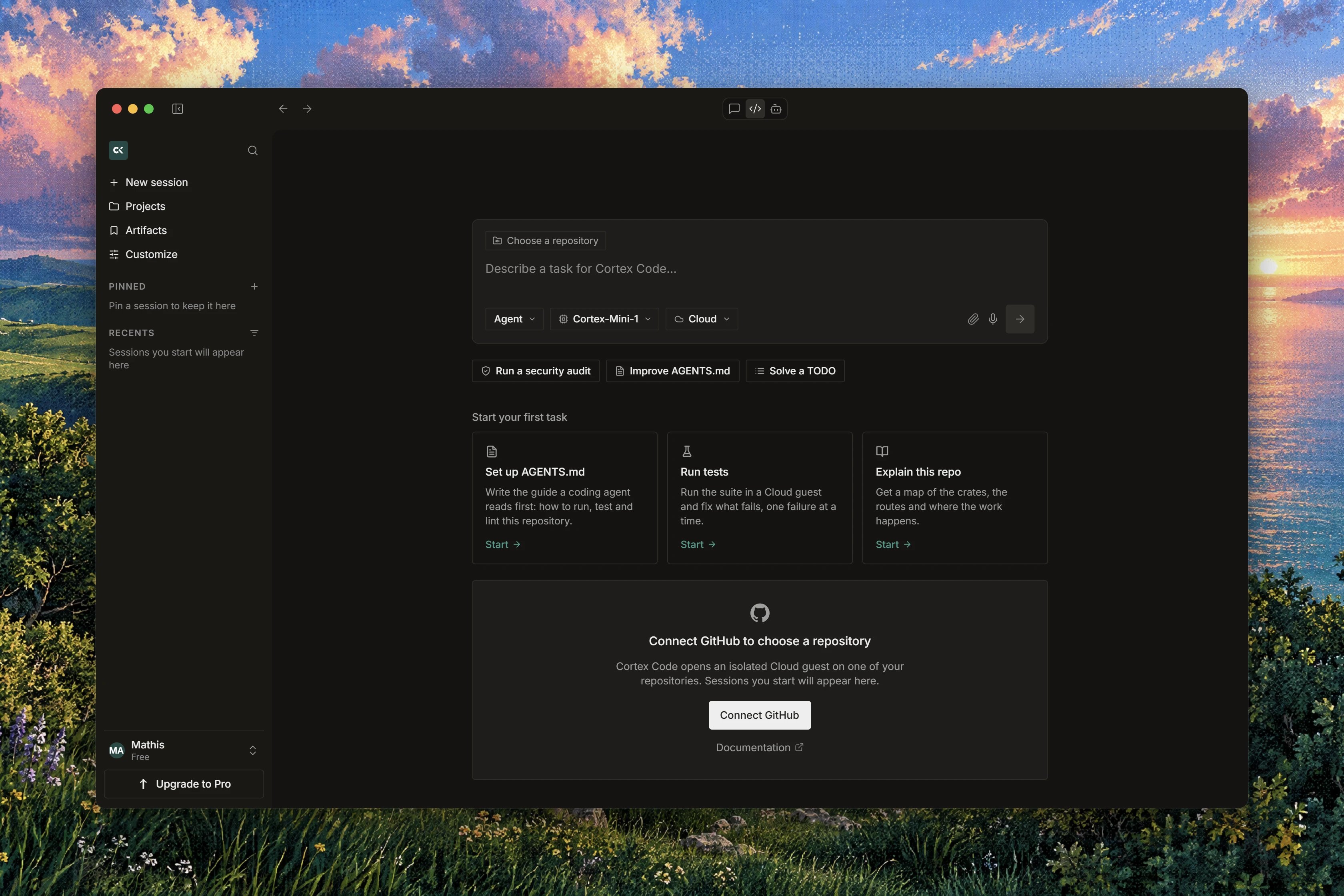
Interface preview
Start here
Code quickstart
Sign in, connect GitHub, run a first Cloud session and approve the change it proposes.
How Code works
The turn loop in user terms: where tools run, what each mode withholds, how a turn ends.
Work in a session
Code sessions
The session object, the board, the transcript, follow-ups and what survives a turn.
Ask, Plan, Agent
The three interaction modes, what each may reach, and switching per turn.
Permissions and approvals
Allow once, Always allow and Deny for commands, plus the separate gate on file writes.
Changes and diffs
The Changes pane, a proposed diff before a write and a landed diff after it.
Tickets
Tickets as a unit of asynchronous work, and why they have no screen in the app yet.
Where code runs
Cloud runtimes
The isolated Cloud guest a session attaches, how it is prepared, and what happens without capacity.
Environments and images
Running machines and saved images, so the next session on a repository skips the install.
Machines
Cloud occupancy and team runners, and why desktop hosts are not offered in the browser.
SSH hosts
Register a remote host in the desktop app, then select it for a session from there or from the CLI.
Code on desktop
This PC and SSH exist in the desktop app and the CLI. The browser stays on Cloud.
Repositories
Connect GitHub
One control, no tokens to paste, and what to do when a connection lapses.
Repositories and branches
Pick the repository and the base branch, and work in the session’s own isolated worktree.
Automate and monitor
Automations
Saved instructions with a trigger, a repository and a prompt, and what a run does today.
Code notifications
The inbox that tells you when a session finished or needs a decision.
Usage
Recorded cost and billable actions over a 7, 30 or 90 day window.
Configure
Code settings
Default model and fallback models, and the settings that are not configurable yet.
Code integrations
Connected apps, repositories and tool servers for the workspace.
Reference
Code in the terminal
The same sessions from a terminal, and how CLI words map onto Code words.
Pull-request review
Where Cortex Security sits under Code, and which tab documents it.
Code troubleshooting
Gates that will not open, a runtime that is unavailable, and modes that will not edit.
Where a session runs
Everything a turn does happens inside the runtime it attached. Nothing runs in your browser.
Modes in one line
Ask answers questions and reads files. Plan writes a reviewable plan. Agent edits files, runs commands and opens a pull request. The choice is a lock on the tools the turn is built with, so a change applies to the next turn, not to the turn already running. The composer’s fourth row, Security, is not a fourth mode: it leaves for Cortex Security. See Ask, Plan, Agent.Two gates, and they are not the same
A command that needs a decision raises a card above the transcript with Allow once, Always allow and Deny. A file write never uses that card: it waits in the Changes pane for a human Approve, per file or as Approve all, and a session-level Always allow never covers a write.What Code is not
- Not a hosted development environment. There is no screen in a Code runtime.
- Not a place to store secrets. Code has no Secrets page and never asks you to paste a token.
- Not a continuous integration system. It runs your commands in a session, on request.
- Not a chat about your code. It edits the repository and opens pull requests.
Not available yet
- Tickets have no screen in the app; they are an API level concept today.
- A session’s Desktop tab is drawn with the badge Soon.
- Automations are saved instructions only: Schedules and events do not execute yet.
- A Code session has no tool servers, connectors or plugins of its own, so do not plan work around attaching one to a session. See Code integrations.
How it fits with the other products
- Cortex Chat shares the account and the sidebar. Chat talks about your code; Code changes it. See Cortex Chat.
- The Cortex CLI drives the same sessions from a terminal, and a session it started is marked · Started from CLI on the board. See Code in the terminal and Cortex CLI.
- Cortex Security reads a pull request and posts a review; it lives under Code in the app and is documented in its own tab. See Pull-request review and Cortex Security.
Related
- Code quickstart for a first session end to end.
- How Code works for cause and effect in a turn.
- Code sessions for the board and the transcript.
- Permissions and approvals for the two gates in full.
- Code troubleshooting when something will not start.