

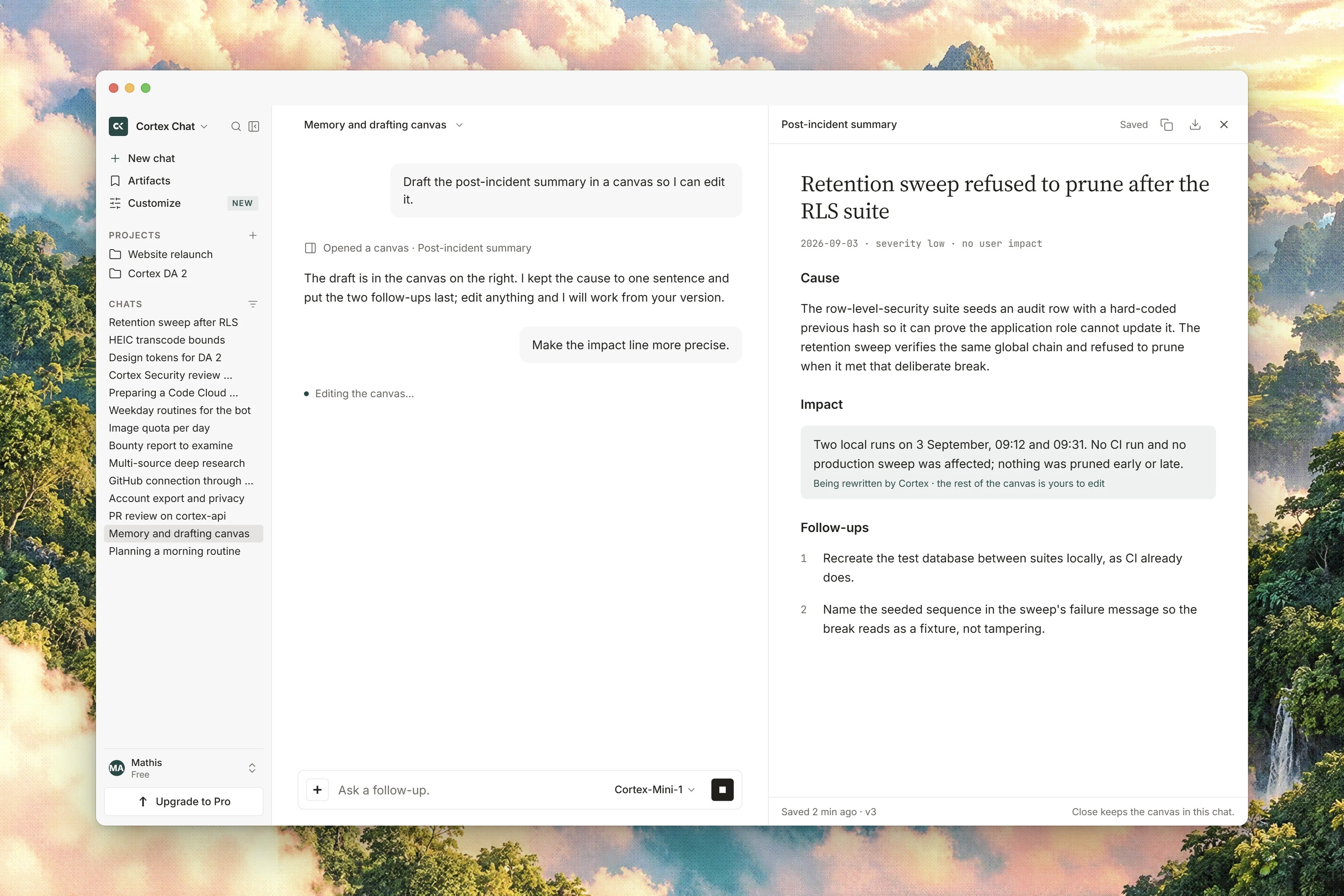
Interface preview
Open a canvas
1
From the composer
Type
/ in the composer to open the slash palette, then choose Canvas. Its hint reads Open a document. The rail opens on an empty document.2
From something Cortex already wrote
Select text inside an answer. The selection menu, Selected answer actions, offers Start writing, which starts a canvas from that selection.
3
Back to it later
A canvas belongs to the conversation it was created in, so reopening that conversation is how you get back to the document. A conversation link can also carry a document reference, in which case the rail opens on that document straight away.
Work in the document
The rail has two fields. The title field is Document title, with the placeholderUntitled document. The body field is Document body, with the placeholder Start writing, or ask Cortex to draft this document.
You do not save the document yourself. About half a second after you stop typing, the rail saves what you have written: the status reads Saving… while the save is in flight and Saved when it lands. Close puts the rail away and flushes any pending save before it closes, so closing the rail immediately after a sentence does not lose the sentence.
Ask Cortex to write into it
Once the rail is open, the conversation is your editor of last resort: ask in the composer for the change you want, in the same words you would use with a person. “Tighten the intro.” “Add a section on pricing.” The rail refreshes as Cortex writes, and you can keep typing in it meanwhile. A canvas is a document Cortex writes into, not a draft message waiting in the composer, so nothing is pending for you to send. The model a conversation uses is chosen when the chat starts and does not change for that chat. See Models and thinking.Canvas, plan, note, or file?
Four different objects can come out of one conversation, and only the first of them is a canvas.
A Chat canvas is a text document attached to one conversation and opened from that conversation. It is not a design surface, and it is not a file inside a Code session.
Save a selection as a Library note
When you only want to keep a paragraph, a note is lighter than a canvas.1
Select the text in the answer
Choose Save to Library from the selection menu.
2
Name it
The dialog Save as Library note explains:
Edit the title before saving this selection as a Library document. Edit the Title field.3
Save
Press Save note. The confirmation reads
Note saved to Library, and the dialog states the scope: Saved in Chat Artifacts. Available from Chat, Code and Bot. If it fails, the message is The note could not be saved with Please try again.How many canvases one conversation can hold, and how large a single canvas can be, are not published limits. If you are drafting something long, keep a copy outside Cortex as you go.
Related
- Conversations for what else the transcript header can do with a chat.
- Export documents to turn an answer into a file.
- Library for where saved notes and attachments live.
- Planning for the task-list object linked to a chat.
- Design canvases for the other thing called a canvas.