

Turn it on
Open the model chip’s panel under the composer and switch on Deep Research, listed under the THINKING heading asPlan the questions, read live sources and write a cited report. While it is on, the chip’s detail line reads · Deep Research.
From an empty Home screen, the Research app card does the same thing and seeds the ask for you.
Then describe what you want to know. The more specific the ask, the sharper the plan.
Review the plan
Nothing is searched until you say so. Cortex first writes a Research plan on the thread: a Plan title, a numbered list of Research questions, a labelled Outline, and a small Plan diagram of the approach.- Edit any question in place, or use Add a question and type into
Another question. A counter reads{count} of {max} questions. - Remove questions you do not care about. Fewer, sharper questions beat a long list.
- The plan survives a page reload, so you can leave it and come back.
- When you are happy, choose Start research. The plan disappears from the thread once the run begins.
Scope it with Trusted sources
Trusted sources is the scoping control, and its own line explains the rule:Only these hosts, connected apps, and project files are cited. Leave hosts empty to search the open web.
Hostnames only, and at most five. A URL is not a hostname, and the refusals say so:
Use hostnames only — not URLs, IP addresses, or more than five names. If you have narrowed the list to nothing you get Add at least one hostname before starting. An empty list does not search the web.
You can also say that no connected app should be consulted. Where you have none attached to Chat, the panel reads No connected apps on Chat.
When a run was scoped, the report tells the reader: Citations are shown only when they match the trusted domains for this run.
While it runs
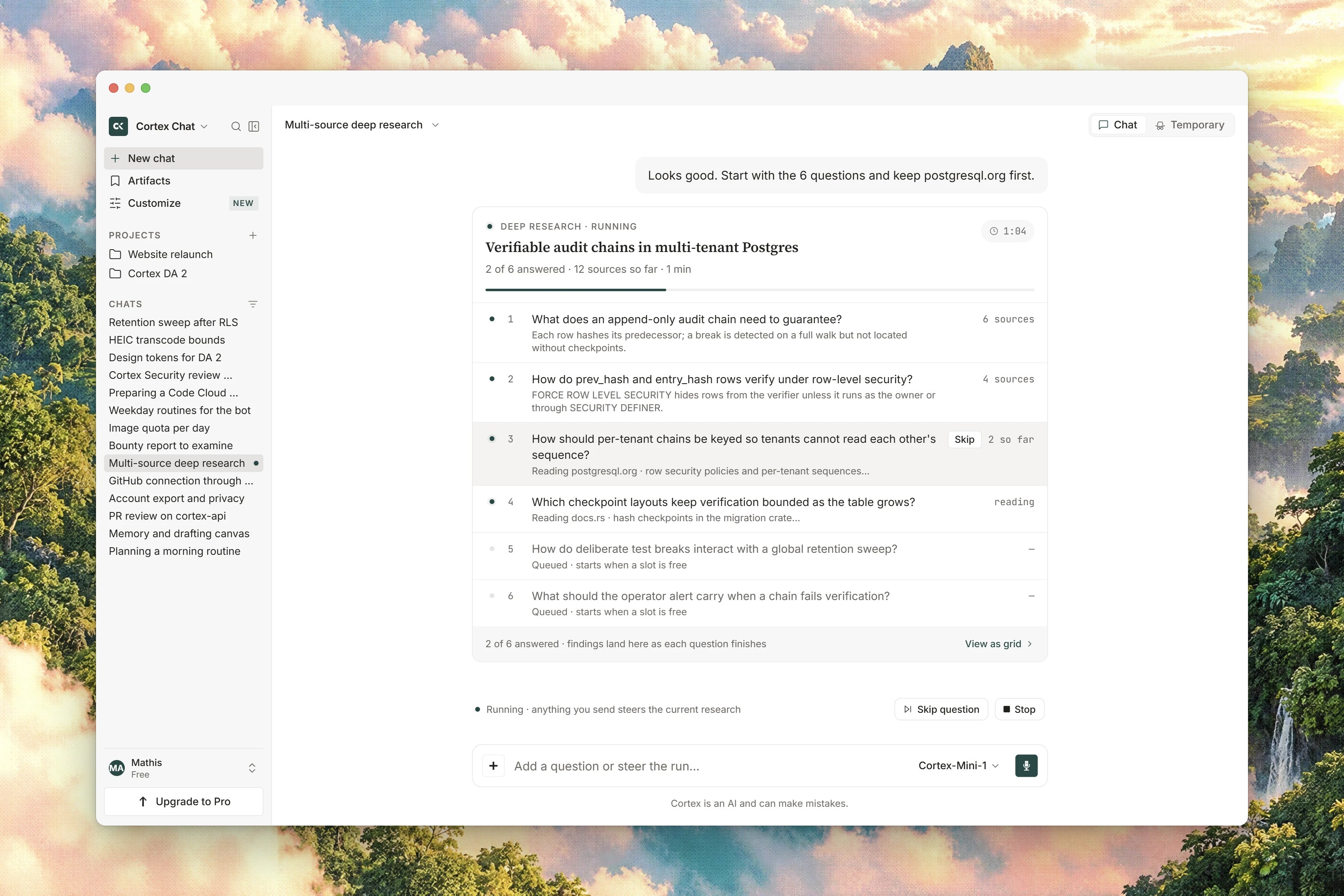
Progress is a short status line, not a wall of tool rows. Research progress moves throughQueued, Searching, Reading, and then Done or Failed, and the line beside it uses a small fixed vocabulary: Planning the research, Searching the web, Reading sources, Checking {topic}, Filling gaps, Writing the report, Checking connected apps. The eyebrow above the block reads Deep Research · Running.
Interface preview
- Stop ends the run.
- Write with what you have tells Cortex to stop searching and write the report from what it has already found. Use it when the status line has been grinding through the long tail of a question you no longer need.
Read the report
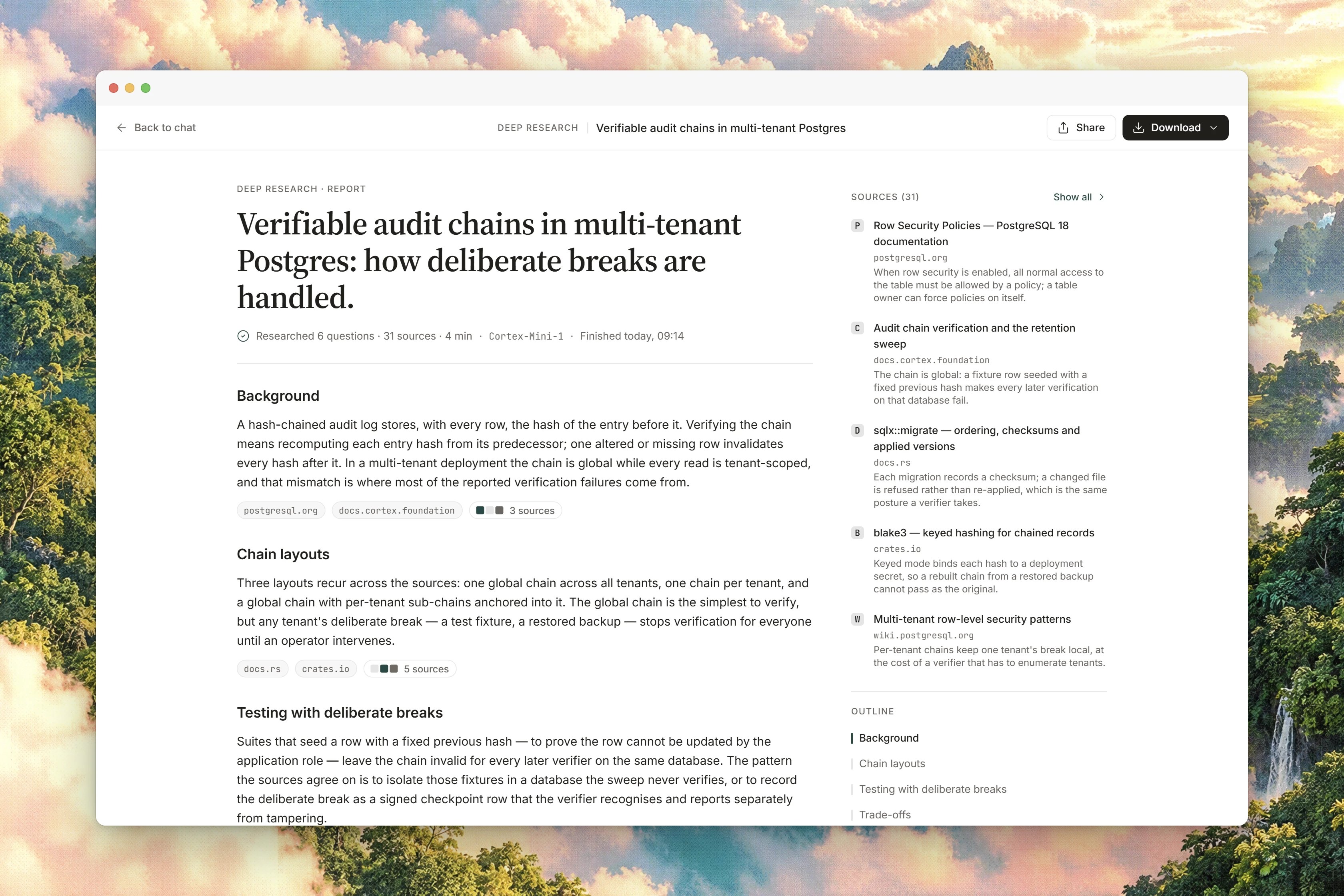
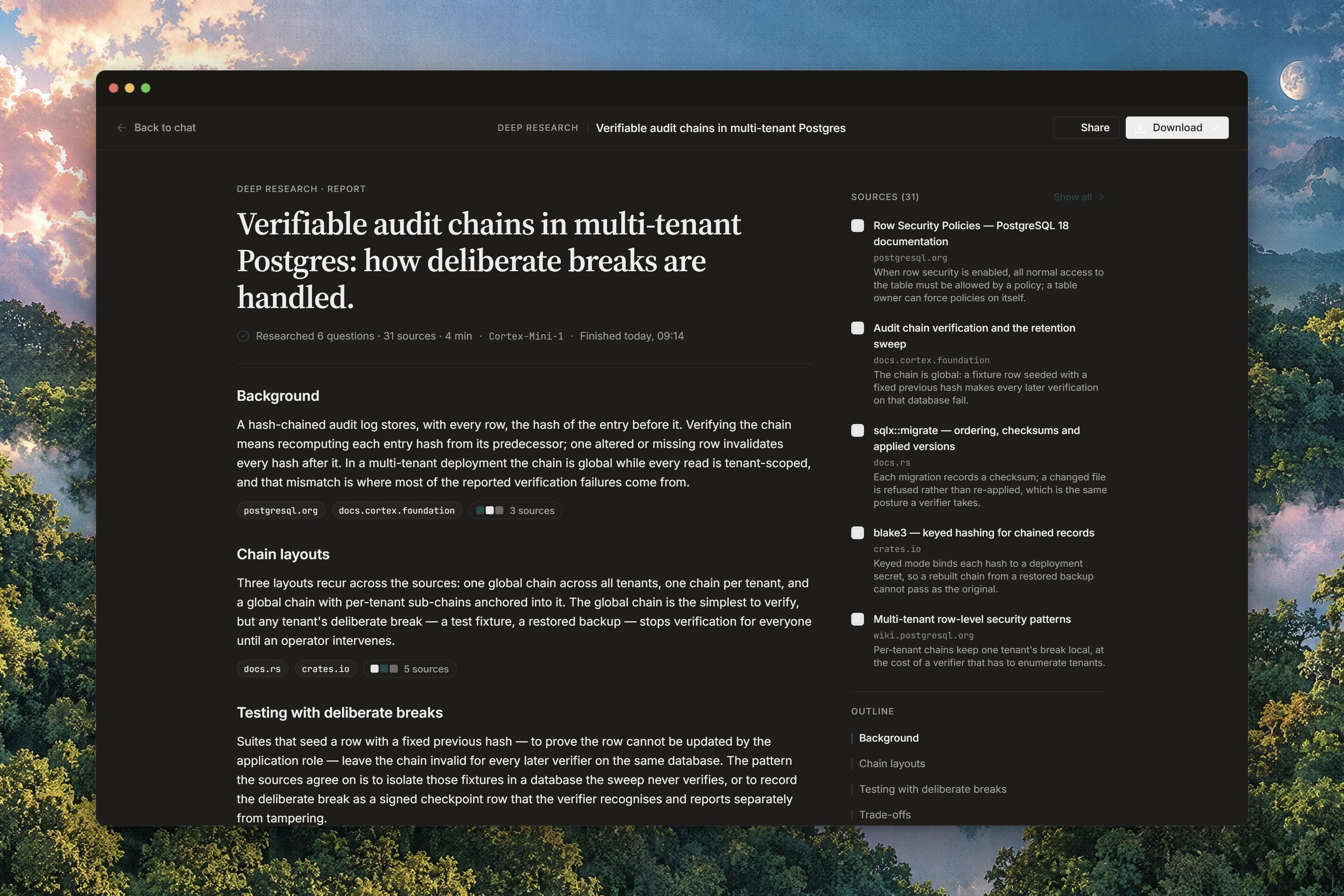
The finished report is ordinary Chat text with numbered citations, under the eyebrowDeep Research · Report. Each citation carries the page’s title, its domain, and the sentence it supports, and the Sources list is grouped into Web, Connected apps and Project. Every report ends with the disclosure sentence, This report was generated by Cortex Chat Deep Research.
Open reader opens the report on its own, away from the thread, and Follow up takes you straight back into the chat with it in hand. Close report returns you to the conversation.
Interface preview
No sources were cited. or No sources recorded for this report. rather than an invented list.
Save the report as a file
The report card carries an Export menu with four items:Markdown (.md), PDF, Word and Deck.
When an export does run, it saves into your Library rather than downloading to your machine, confirmed with Saved to Library as {filename}. and findable under the Library’s Reports filter. The report card shows In Library once it is there.
Two more conditions apply. Export stays off until the report cites at least one source, Export stays off until this report cites at least one source., and a guest is asked to sign in first, Sign in to export this report. Exports also draw on a daily allowance that depends on your plan; see Export documents and Plans and quotas.
Limits
Deep Research runs on a Chat conversation. It is refused on a Cortex Code conversation, where the tools are a session’s own. Guests may run it, though they cannot export the result.
When it cannot run
Research could not reach the web. Try again.
Research could not reach the web. Try again.
The run could not get out to the open web at all. Retry. If it persists, check status.cortex.foundation.
This report is not available. / The research report could not be loaded.
This report is not available. / The research report could not be loaded.
The reader could not fetch the report. Return to the thread, where the report block itself is still there, and open it again.
This format is not available yet.
This format is not available yet.
You chose PDF, Word or Deck. Choose Markdown, the format that is implemented.
Nothing happens when I press Export
Nothing happens when I press Export
Check that the report cites at least one source and that you are signed in. Both turn the menu off.
Related
- Models and thinking - the chip panel where Deep Research is switched on.
- Built-in tools - the ordinary tool loop a research run replaces.
- Library - where an exported report is saved.
- Export documents - the formats Chat can produce and the daily allowance.
- Connectors - connected apps a run may consult and cite.
- Planning - turn a report into a task list.