

Interface preview
Ask for a picture
1
Describe the picture in the composer
Write what you want as a sentence rather than a list of keywords. You can attach reference files on the same turn: a Chat turn takes at most four attachments, and each file has to be within the 10 MB per-upload ceiling, which is the same for everyone whatever your plan.
2
Let the card work
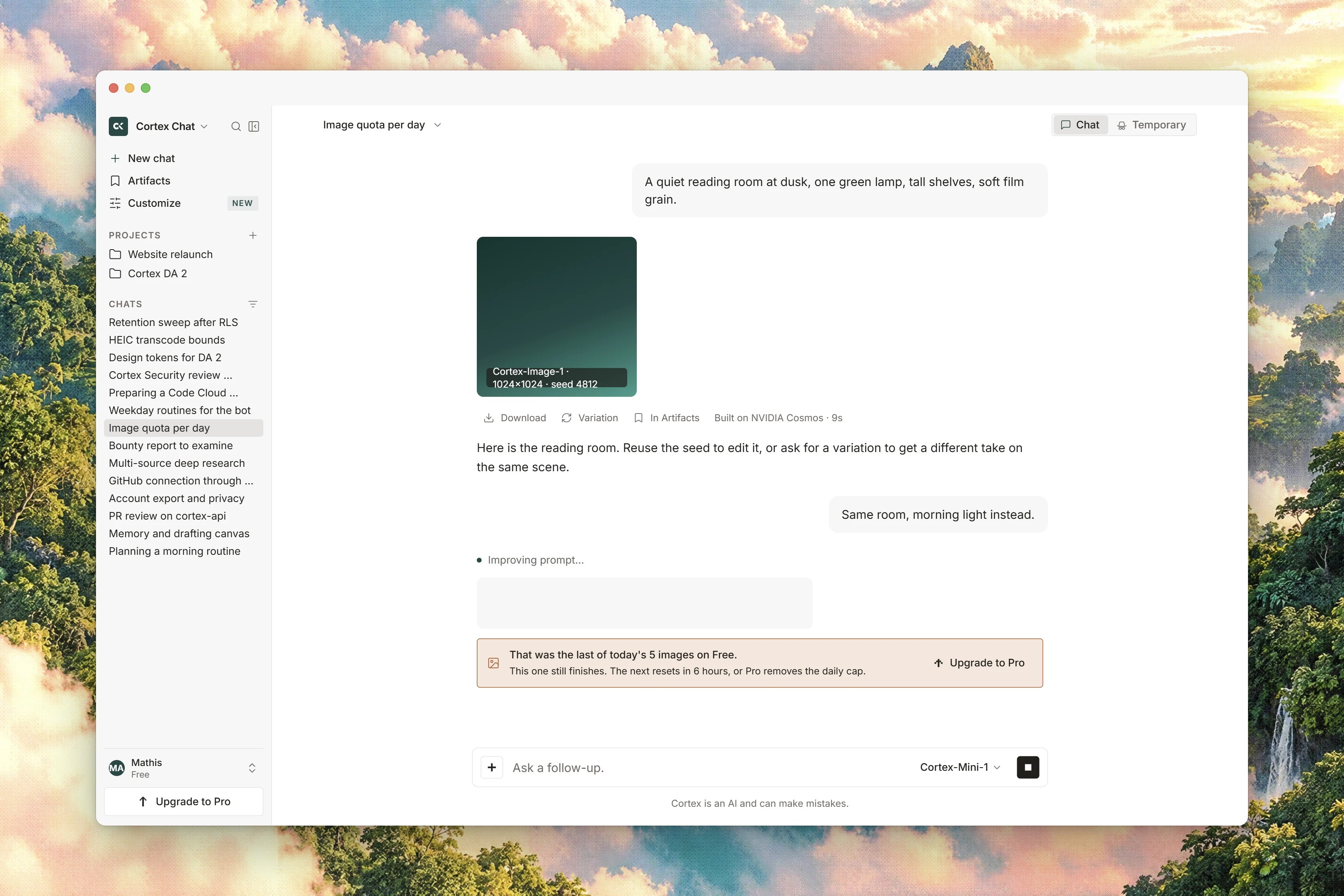
The card first shows Improving prompt…, while Cortex turns your ask into a complete scene description, then Generating image… while the picture is made.
3
Read the result
The tile fills with the picture and the caption gives the model name and how long it took, as
Cortex-Image-1 · {seconds}s. Elsewhere the same result is labelled Generated with Cortex-Image-1.What the card shows
Retry re-runs whichever step failed, the prompt rewrite or the generation. Where neither can be re-run, the button is absent rather than present and dead.
A card that reads done means the generation finished, not that the picture has painted: the tile fills once the file arrives from your Library. Closing the conversation settles any generation still in flight.
Steer the result
You can set the following on the ask itself.
Cortex gives the prompt rewrite about 45 seconds and the generation itself about two and a half minutes. Past that the card reports the error instead of waiting indefinitely.
Where the image lands
The finished picture is saved to your Library as a generated file, and it does not spend your per-upload allowance the way an upload does. From there you can reuse it in another chat or attach it to a project. The card and the Library keep the picture’s provenance: the prompt you typed and the seed, never the rewritten prompt Cortex generated from it.- Image history on the card shows the prompt, the seed, the size and the date.
- Reuse seed puts the prompt and the seed back in the composer, so you can change one thing and try again rather than generating from the dialog.
Included images per day
Image generation is metered per day, and the allowance depends on your plan. The Go plan’s figure is not published, so this page will not invent one: check Settings → Plan & billing on a Go account for what it allows.When a generation fails, nothing is counted. The card says so, and where the allowance is known it says how much is left, as
Nothing was counted — {remaining} of {limit} included images left today on {plan}. The prompt rewrite spends the allowance before the generation runs, which is exactly why a failure has to give it back.quota_exceeded rather than generating a lesser picture.
When nothing runs
- A web address in the prompt. A prompt that contains a link is refused before either step. Neither the rewrite nor the generation happens, and nothing is counted. Describe the reference instead, or attach the file.
- An attachment the turn cannot read. PNG, JPEG, WebP, GIF, PDF, JSON and ordinary text types are accepted; HTML, XML and JavaScript are not, and SVG is refused.
- A deployment without image generation. Where the image stack is not configured, the tool is simply not offered in the turn.
Related
- Library is where generated pictures are kept.
- Attachments and files covers the per-turn and per-file limits.
- Origin check answers whether a photo or clip is authentic.
- Built-in tools lists what else a Chat turn can call.
- Plans and quotas has the per-plan allowances in one place.