

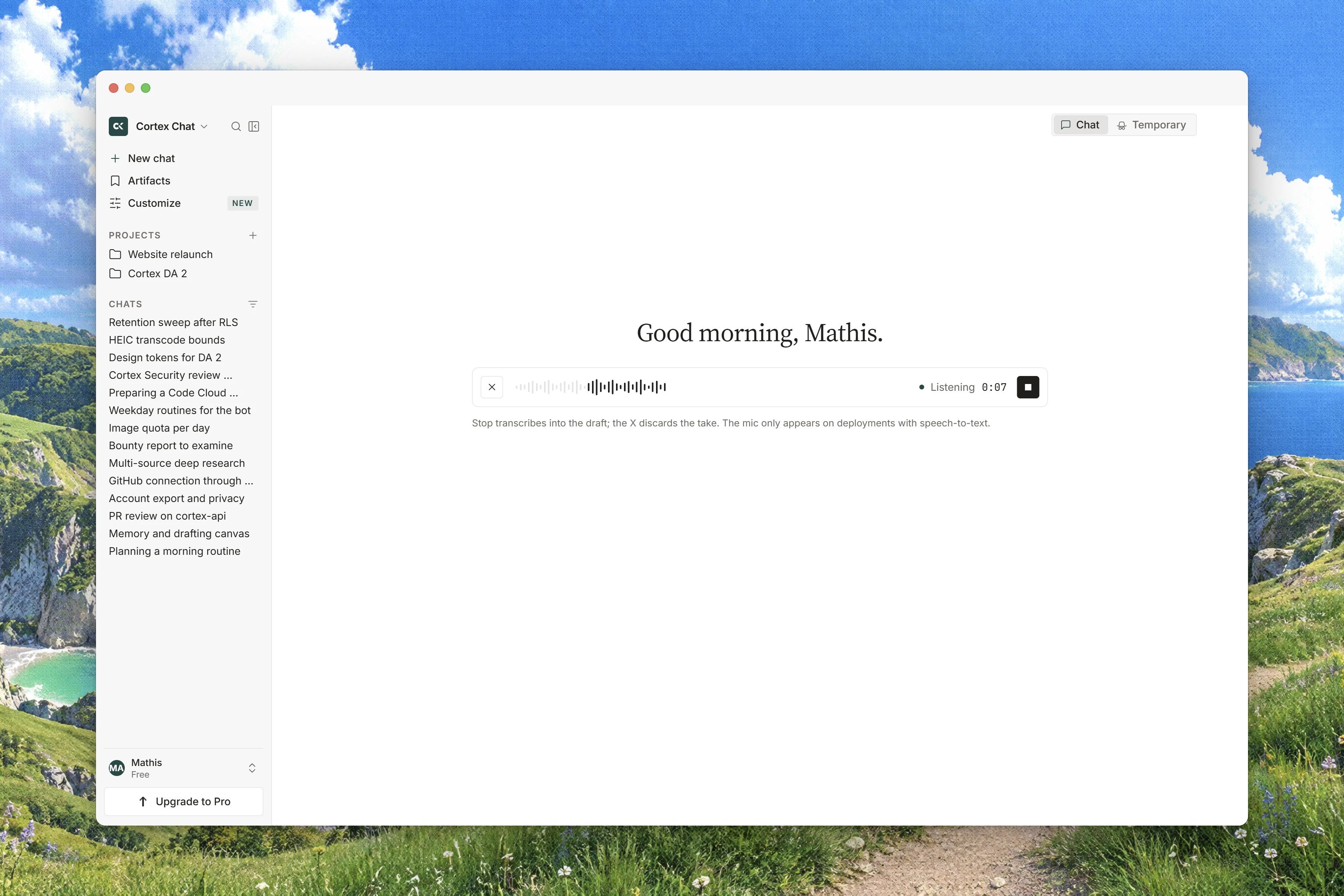
Interface preview
The two controls
Each control appears only where the capability behind it is configured. Cortex asks once whether speech-to-text and text-to-speech are available and draws the controls accordingly, so a control you can see is a control that works. Nothing is drawn greyed out, and you will not meet a button that fails when you click it.
Dictate a message
1
Start recording
Click Voice input in the composer. If the button is not there, dictation is not configured where you are running Cortex.
2
Speak
The button becomes Stop recording while the clip is being captured.
3
Stop and wait for the text
Stop recording. The composer shows Transcribing…, then drops the transcript into the message box as ordinary editable text.
4
Read it, fix it, send it
Correct anything that was misheard and send the message yourself.
Dictation never sends for you. The transcript lands in the composer and stays there until you press send, which is what makes it safe to dictate a long message and then edit it.
Listen to an answer
1
Choose Listen
On a finished answer, choose Listen. If there is no such button, read-aloud is not configured where you are running Cortex.
2
Wait for the audio
The button shows Loading… while the audio is prepared, then playback starts and the button becomes Stop.
3
Stop when you like
Stop ends playback. Starting playback on a second answer stops the first one, so only one answer is ever read aloud at a time.
Limits
For everything else, a dictated message counts against your message allowance exactly like a typed one, because by the time it is sent it is a typed one. See Plans and quotas.
A live voice conversation is not available yet
Use them together if you want something close to a spoken exchange: dictate the question with Voice input, send it, then press Listen on the answer. The difference is that each half is a deliberate action rather than an open microphone, and nothing is recorded between them.When a control is missing
A missing mic or a missing Listen button is not a fault on your side, and there is nothing in your own settings to switch on. Each half is configured where Cortex is running, and either can be available without the other.
If the mic button is present but your browser never starts recording, the block is usually the browser’s own microphone permission for the site rather than Cortex. Allow the microphone in your browser’s site settings and try again.
Interface language is a separate matter from the voice controls and is covered in Language.
Related
- Streaming and reconnects - an answer has to finish before it can be read aloud.
- Conversations - the rest of the controls on an answer.
- Chat troubleshooting - a missing mic or a silent Listen button.
- Getting started troubleshooting - what a missing control means in general.